
If you are aiming to accelerate your financial growth and effectively leverage your positions within the digital asset ecosystem, understanding derivatives is a paramount milestone. This comprehensive Bybit Futures Trading Guide is systematically structured to take both enthusiastic beginners and mid-tier day traders through the platform’s mechanics safely in 2026. Bybit has earned its stellar reputation as a premier cryptocurrency derivatives destination, providing global market participants with an ultra-fast matching engine, institutional-grade security protocols, and minimal order book slippage.
In this step-by-step Bybit Futures Trading Guide, we will carefully map out how the live interface functions, how to manage your leverage parameters intelligently, and how to execute your very first contract without committing costly technical mistakes.
🎁 Elite Trading Reward: Want to optimize your initial market entry? Register your account through our official [Bybit Registration Link] right now to instantly unlock up to $30,000 in premium welcome bonuses and secure an elite lifetime trading fee discount!
Laying the Risk Foundation: Cross Margin vs. Isolated Margin
Before you submit a single dollar into the live order book, this Bybit Futures Trading Guide heavily emphasizes the critical choice between available margin modes. Selecting the incorrect mode can drastically expose your collateral to unnecessary liquidations.
1. Cross Margin Mode (Ecosystem Risk)
In Cross Margin mode, the trading system utilizes the entirety of your available equity within the Unified Trading Account (UTA) to maintain your open positions and prevent liquidation. While this yields a wider breathing room for volatile market fluctuations, a massive, unmanaged price dump against your trade can completely drain your entire account balance.
2. Isolated Margin Mode (Strict Collateral Separation)
In Isolated Margin mode, your financial risk exposure is absolutely locked to the precise amount of margin capital you manually designated for that individual contract. If the market aggressively hits your liquidation target, you only lose the initial margin assigned to that single position, keeping the rest of your funds completely untouched. For anyone practicing leverage for the first time, we ruthlessly advocate utilizing Isolated Margin.
Step 1: Allocating Capital to Your Unified Trading Account
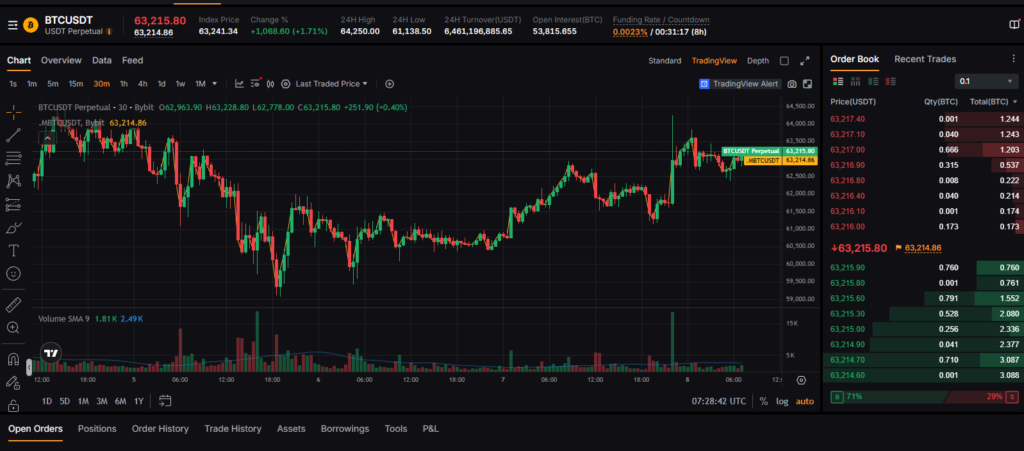
To begin placing live leverage orders on the world’s most stable derivatives machine, follow these precise deployment steps:
- Secure Access: Log in to the exchange using our verified [Bybit Registration Link] to guarantee all premium partner rebates are fully hardcoded into your profile.
- Asset Allocation: Locate your master wallet interface and transfer your USDT stablecoins into the “Unified Trading Account (UTA)”.
- Enter Derivatives UI: Hover over the main top navigation menu, select [Derivatives], and click on [USDT Perpetual]. From there, choose your preferred trading pair, such as BTCUSDT.
Step 2: Calibrating Leverage and Choosing Order Types
Leverage is a highly potent tactical mechanism that operates as a strict double-edged sword; it expands your capital efficiency and gains just as rapidly as it compounds your losses.
Essential Interface Variables:
- Set Leverage Scale: Adjust your risk multiplier using the configuration box on the right dashboard panel. While the platform offers substantial leverage limits, we strictly advise retail beginners to cap their exposure between 2x and 5x initially.
- Limit Orders (Maker Class): Input a distinct, specific price target where you want your order to enter the book. Limit orders ensure you act as a liquidity provider, saving you immense capital on taker premiums over time.
- Market Orders (Taker Class): This execution type triggers instantaneously at the absolute best available current market price. Utilize this strategy only during emergency situations where an instant exit or entry is mandatory.
Step 3: Launching Long and Short Market Contracts
The primary advantage discussed inside this Bybit Futures Trading Guide is your ability to harvest profits regardless of whether the macroscopic crypto market is trending upward or crashing down.
- Buy / Long Order: Open a Long position if your mathematical chart patterns suggest the asset value is poised to move upward.
- Sell / Short Order: Open a Short position if your technical indicators indicate the asset value is heading downward.
⚠️ The Golden Risk Rule: Never establish an open position without configuring your Take Profit (TP) and Stop Loss (SL) triggers. Automating these exit barriers guarantees that sudden flash crashes will not liquidate your portfolio while you are away from your screen or sleeping.
Conclusion: Cut Your Overhead to Protect Your Yield
Developing consistent success in the crypto derivatives space requires immense emotional grounding and calculated risk distribution. As we conclude this Bybit Futures Trading Guide, always internalize that protecting your principal capital is your most important objective as a trader.
To lock in maximum net returns, you must also eliminate structural execution friction. Be sure to study our ultimate guide on [How to Reduce Bybit Trading Fees] to learn how to combine our elite partner links and limit order strategies to minimize your transaction drag to the absolute bare minimum!
1 thought on “Bybit Futures Trading Guide 2026: How to Trade Safely”